Tokenized Assets vs Real-World Assets: What Do Investors Actually Own?
CopyM Team
Research Team
Tokenized assets are often described as digital versions of real-world assets, but that explanation can be misleading. In practice, a token may represent legal title, beneficial ownership, a contractual claim, a fund interest, a redemption right, or only economic exposure. For investors and institutions, the key question is not whether an asset is tokenized, but what rights the token actually gives them.
- A real-world asset is the underlying off-chain asset, such as property, gold, private credit, receivables, art, or a luxury collectible.
- A tokenized asset is a digital representation of rights, records, claims, or economic interests connected to that real-world asset.
- Buying a tokenized asset does not always mean owning the physical asset directly. The token may represent legal title, beneficial ownership, a contractual claim, fund interest, revenue entitlement, redemption right, proof of authenticity, or only economic exposure.
- The most important question is not “Is this asset tokenized?” The better question is: What legal right does the token actually represent?
- For institutional-grade tokenization, ownership must be supported by legal documentation, custody arrangements, investor eligibility controls, transfer rules, reporting workflows, and clear disclosures.
Direct Answer: What Do Investors Actually Own?
Investors in tokenized real-world assets usually own a digital token that represents a defined legal or economic relationship to an underlying asset. That relationship depends on the token structure.
In some cases, the token may represent beneficial ownership in an asset held by a custodian or special-purpose vehicle. In others, it may represent a contractual right to income, a fund interest, a debt claim, a redemption right, or proof that a specific asset has been verified.
The token itself is not automatically the same as owning the physical asset. A token connected to a building does not necessarily make the holder the direct owner of the building. A token connected to gold does not always mean the holder can redeem a specific gold bar. A token connected to private credit does not always mean the holder owns the underlying loan directly.
That is why tokenized asset ownership must always be evaluated through the legal documents, custody model, asset verification process, transfer restrictions, and investor disclosures behind the token.
Real-World Asset vs Tokenized Asset: The Basic Difference
A real-world asset is the actual off-chain asset.
A tokenized asset is the digital representation of rights or records connected to that asset.
For example:
A commercial building | A digital token representing an economic interest, beneficial ownership record, or claim linked to that building |
A gold bar | A token representing allocated gold, pooled gold exposure, or a redemption claim |
A private credit agreement | A token representing a debt interest, income right, or participation in a credit structure |
A luxury watch | A token representing proof of authenticity, ownership record, membership access, or resale entitlement |
A fund interest | A tokenized record of participation in a regulated or private fund structure |
The physical or legal asset remains off-chain. The token sits on digital infrastructure and connects to that asset through contracts, custody, documentation, and operating rules.
The Most Important Principle: The Token Is Not Always the Asset
One of the biggest misunderstandings in RWA tokenization is assuming that a token equals direct ownership of the underlying asset.
That is not always true.
A token may be:
a direct digital ownership record;
a beneficial ownership record;
a contractual claim;
a debt or credit instrument;
a fund interest;
a revenue participation right;
a redemption claim;
a proof-of-provenance certificate;
a membership or access right;
a synthetic exposure product;
a platform ledger entry connected to off-chain records.
These structures can look similar on the surface because they all use tokens. But legally and economically, they can be very different.
For investors and institutions, the key question is:
If I buy this token, what exactly do I have the legal right to receive, claim, transfer, redeem, or enforce?
Why Ownership Clarity Matters
Tokenization can make asset records more digital, programmable, and easier to transfer. But it can also create confusion if the token’s rights are not clearly explained.
Ownership clarity matters because it determines:
whether the holder owns the asset directly or indirectly;
whether the holder has economic exposure only;
whether income distributions are owed;
whether redemption is possible;
whether the token can be transferred;
who holds the underlying asset;
what happens if the issuer fails;
what happens if the custodian fails;
whether the token is recognized under applicable law;
whether investors have recourse to the asset, issuer, platform, or another party.
A tokenized asset is only as strong as the legal, custody, and operational framework behind it.
The Ownership Stack Behind a Tokenized Asset
Institutional tokenization usually involves several layers.
1. The Underlying Asset
This is the actual real-world asset: property, gold, private credit, receivables, equipment, art, luxury goods, carbon credits, or another asset.
2. The Legal Wrapper
The asset may be held through a company, fund, trust, nominee, special-purpose vehicle, custody arrangement, or contractual structure.
The legal wrapper defines who owns the asset and how rights are passed to investors or participants.
3. The Issuer
The issuer is the entity that creates or authorizes the tokenized structure. The issuer defines the rights, terms, risks, transfer rules, and lifecycle events.
4. The Custodian
The custodian may hold the underlying asset, the token, or both, depending on the structure.
In institutional models, custody is often central to investor protection because it helps separate asset control from platform operation.
5. The Platform or Registry
The platform may manage investor onboarding, eligibility, transaction records, reporting, and beneficial ownership records.
In some models, the platform ledger or registry is the authoritative record of who has economic or beneficial ownership.
6. The Token Holder
The token holder may own direct legal title, beneficial ownership, contractual rights, fund interests, redemption rights, or economic exposure depending on the structure.
This is the layer investors usually see first, but it is only one part of the ownership stack.
Legal Title vs Beneficial Ownership vs Economic Exposure
These three concepts are essential.
Legal Title
Legal title means formal legal ownership of the asset or instrument. The legal title holder is the person or entity recognized under the relevant legal framework as the owner.
In some tokenized structures, token holders may not hold direct legal title. Instead, a custodian, nominee, fund, trustee, or SPV may hold legal title on behalf of investors.
Beneficial Ownership
Beneficial ownership means the investor receives the economic benefits or rights linked to the asset, even if another entity holds formal legal title.
For example, a custodian or nominee may hold the asset while the platform records each investor’s beneficial ownership.
Beneficial ownership can be suitable for institutional tokenization, but it must be clearly documented and reconciled.
Economic Exposure
Economic exposure means the investor’s return is linked to the performance of an asset, but the investor may not own the asset itself.
This can create additional counterparty risk because the investor may depend on the issuer or product provider to honor the exposure.
This distinction is critical. A token that tracks the price of gold is not the same as a token that gives a legal claim to allocated gold.
Common Tokenized Asset Ownership Models
1. Direct Ownership Token
In this model, the token is designed to represent direct ownership of the asset or asset interest.
This is difficult to implement for many physical assets because legal systems may still require traditional ownership records, registries, contracts, or notarial processes.
Best suited for: digitally native assets, certain registry-based instruments, or jurisdictions where token-based title recognition is clear.
Investor question: Is the token legally recognized as the ownership record?
2. Beneficial Ownership Token
In this model, the underlying asset is held by a custodian, trustee, nominee, or SPV, while token holders are recorded as beneficial owners.
This structure is common in institutional frameworks because it separates custody from investor records and can support compliance controls.
Best suited for: real estate, private credit, commodities, structured products, and asset-backed vehicles.
Investor question: Who holds legal title, and how is my beneficial ownership protected?
3. Asset-Backed Claim Token
In this model, the token gives the holder a claim against an issuer or structure backed by underlying assets.
The investor may not own the asset directly. Instead, the investor has rights defined by the issuer’s terms.
Best suited for: receivables, credit products, asset-backed financing, commodity-backed products.
Investor question: Is my claim secured, unsecured, redeemable, or dependent on issuer performance?
4. Fund Interest Token
In this model, the token represents an interest in a fund or investment vehicle.
The underlying assets are held by the fund, not directly by the token holder. The token may make subscription, transfer, and reporting more efficient.
Best suited for: private funds, money market funds, real estate funds, private credit funds, alternative investment vehicles.
Investor question: Does the token represent a fund interest, and what fund documents govern my rights?
5. Revenue or Profit Participation Token
In this model, the token gives the holder a right to receive a share of revenue, profit, yield, or distributions from an asset or business activity.
This structure requires careful legal and regulatory review because it may resemble a security or investment contract in many jurisdictions.
Best suited for: structured finance, revenue-backed assets, private credit, project finance.
Investor question: What triggers payment, who calculates it, and what happens if revenue is lower than expected?
6. Redemption Claim Token
In this model, the holder can redeem the token for the underlying asset, cash equivalent, or another defined settlement asset.
This is common in commodity-backed structures, but details matter. Redemption may be subject to minimum amounts, fees, geography, custody rules, or eligibility requirements.
Best suited for: gold, commodities, stable-value products, inventory-backed assets.
Investor question: Can I redeem the token, and what exactly can I redeem it for?
7. Proof-of-Authenticity or Provenance Token
In this model, the token does not necessarily represent investment ownership. Instead, it verifies that an asset exists, has been authenticated, or belongs to a known provenance record.
This is especially relevant for luxury goods, art, collectibles, fashion, watches, and ESG-linked assets.
Best suited for: collectibles, luxury assets, art, high-value goods, supply chain records.
Investor question: Does the token prove authenticity only, or does it also transfer ownership rights?
8. Synthetic Exposure Token
In this model, the token provides exposure to an asset’s price or performance without giving the holder ownership of the underlying asset.
This can be useful for access and efficiency, but it introduces important counterparty, disclosure, and regulatory risks.
Best suited for: advanced financial products where legal and regulatory approval is clear.
Investor question: Do I own the asset, or am I relying on the issuer to pay based on asset performance?
Comparison Table: What Investors May Actually Own
Token Structure | What the Investor May Own | Main Risk |
|---|---|---|
Direct ownership token | Legal ownership record or direct title-linked interest | Legal recognition may vary by jurisdiction |
Beneficial ownership token | Economic or beneficial interest in an asset held by another party | Dependence on custodian, nominee, or registry accuracy |
Asset-backed claim token | Claim against an issuer or structure backed by assets | Counterparty and documentation risk |
Fund interest token | Interest in a fund or vehicle holding assets | Fund governance, transfer restrictions, liquidity limits |
Revenue participation token | Right to receive defined distributions | Performance and payment calculation risk |
Redemption claim token | Right to redeem for asset or settlement value | Redemption limits, custody, liquidity mismatch |
Provenance token | Proof of authenticity, origin, or ownership history | May not include financial or ownership rights |
Synthetic exposure token | Economic exposure to asset performance | Issuer counterparty risk and lack of asset ownership |
Example 1: Tokenized Real Estate
Suppose a commercial building is tokenized.
The investor may not own a physical part of the building directly. Instead, the building may be held by a company or special-purpose vehicle, and the token may represent a beneficial interest, fund interest, income right, or contractual claim connected to that vehicle.
The investor should check:
who owns the property title;
whether the token holder has beneficial ownership;
whether income distributions are expected or discretionary;
whether the property is debt-financed;
whether the token can be transferred;
whether the asset is independently valued;
whether there is a redemption or exit mechanism;
what happens if the issuer or platform fails.
A real estate token is not automatically the same as owning a deed.
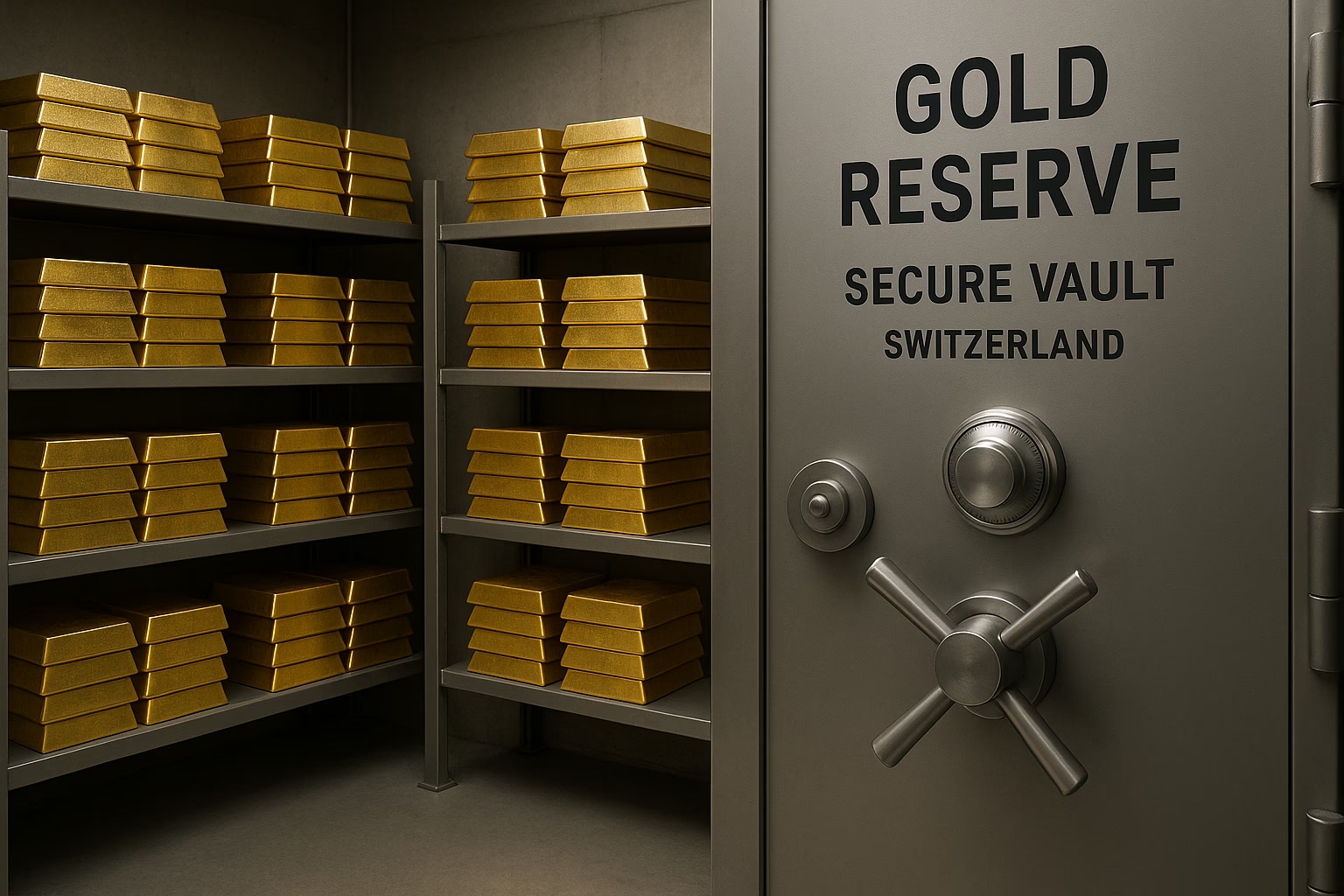
Example 2: Tokenized Gold
Suppose gold is tokenized.
The investor may own:
a claim to allocated gold;
a claim to pooled gold reserves;
a redemption right;
a token tracking the price of gold;
a contractual claim against the issuer.
These are not the same.
The strongest structures usually clarify where the gold is stored, who the custodian is, whether the gold is allocated or unallocated, whether audits are performed, whether redemption is possible, and what happens if the issuer becomes insolvent.
A gold-backed token should answer one simple question clearly:
Is there specific gold behind this token, and does the token holder have enforceable rights to it?
Example 3: Tokenized Private Credit
Suppose a private credit facility is tokenized.
The investor may not own the borrower’s loan directly. Instead, the token may represent participation in a credit vehicle, a note, a receivables-backed claim, or a right to receive defined payments.
The investor should understand:
who the borrower is;
who underwrites the credit;
whether the claim is secured;
what collateral exists;
who controls enforcement;
how payments are calculated;
how defaults are handled;
whether the token is transferable;
whether secondary transfers are permissioned.
In private credit, ownership is usually less about holding a token and more about understanding the credit structure behind it.
Example 4: Tokenized Luxury Collectible
Suppose a luxury watch is tokenized.
The token may represent proof of authenticity, ownership history, membership access, resale rights, or fractional access to a collectible drop.
But unless the structure clearly says so, the token may not give the holder the right to physically possess the watch.
The investor or collector should ask:
who physically holds the asset;
whether the token proves authenticity or ownership;
whether the token can be redeemed for the item;
whether the item is insured;
whether resale rights are included;
whether multiple token holders share rights;
what happens if the asset is damaged, lost, or sold.
For collectibles, tokenization can create value through provenance, access, and verified ownership records, but the physical asset rights must be clearly defined.
On-Chain Ownership vs Off-Chain Ownership
Another important distinction is the difference between on-chain and off-chain ownership.
On-Chain Ownership
On-chain ownership refers to what the blockchain records. It may show that a wallet holds a token.
This can be useful for transparency, auditability, and transfer automation.
Off-Chain Ownership
Off-chain ownership refers to the legal and contractual records that define real-world rights.
For many real-world assets, legal ownership still depends on off-chain documents, registries, contracts, custody agreements, fund documents, or corporate records.
The key issue is whether the on-chain record and off-chain legal record are aligned.
If the blockchain says one thing but the legal documents say another, investors may face uncertainty.
Why Custody Is Central to Tokenized Asset Ownership
Custody determines who controls the token, who controls the asset, and how ownership records are protected.
Institutional tokenization may use:
third-party custodians;
MPC wallet infrastructure;
omnibus wallets;
nominee structures;
platform-led beneficial ownership registries;
investor sub-ledgers;
segregated accounts;
smart contract-based transfer controls.
In some models, investors do not directly hold tokens in their own wallets. Instead, tokens remain under institutional custody while the platform records beneficial ownership internally.
This can support compliance, recovery, reporting, and controlled transfers, but it must be transparent.
The investor should always know:
Am I holding the token directly, or is my ownership recorded through a platform, custodian, or nominee arrangement?
The Role of the Beneficial Ownership Registry
A beneficial ownership registry is a system that records who has the economic or contractual rights connected to an asset, even if the asset or token is held by a custodian or nominee.
In institutional tokenization, this registry can become the main ownership record for investor entitlements.
A strong registry should define:
who owns what;
when ownership changes;
what rights are attached;
who is eligible to hold the asset;
how transfers are approved;
how distributions are calculated;
how records are reconciled with custody data;
how disputes or errors are handled.
This is why tokenization infrastructure is not only about smart contracts. It is also about records, reconciliation, governance, and controls.
What Investors Should Read Before Buying a Tokenized Asset
Investors should not rely only on the token name, asset category, or marketing page.
Before participating, they should review:
offering documents;
asset description;
legal structure;
issuer information;
custody arrangement;
investor rights;
redemption terms;
transfer restrictions;
risk disclosures;
valuation methodology;
reporting schedule;
fee structure;
distribution rules;
default or termination process;
jurisdictional restrictions;
smart contract audit information;
platform terms of use.
The most important document is the one that explains the rights attached to the token.
If those rights are unclear, the ownership claim is unclear.
Investor Due Diligence Checklist
Before buying or participating in any tokenized asset structure, investors should ask:
What is the underlying real-world asset?
Who legally owns the asset?
What does the token represent?
Do token holders have legal title, beneficial ownership, a claim, or exposure only?
Who is the issuer?
Who is the custodian?
Is the asset held separately from the issuer’s balance sheet?
Are there independent valuations or audits?
Can the token be transferred?
Are transfers restricted to eligible participants?
Can the token be redeemed?
What happens if the issuer defaults?
What happens if the platform stops operating?
What happens if the custodian fails?
Are distributions guaranteed, discretionary, or performance-based?
What fees apply?
What jurisdiction governs the structure?
Is the token regulated as a security, commodity, fund interest, utility token, or another instrument?
How are on-chain and off-chain records reconciled?
What disclosures explain the risks?
A credible tokenized asset should make these answers easy to find.
Common Red Flags in Tokenized Asset Ownership
Investors and institutions should be cautious when a tokenized asset project:
says “you own the asset” without explaining the legal structure;
promises liquidity without explaining market mechanics;
uses “asset-backed” without proof of custody or reserves;
does not identify who holds the underlying asset;
does not explain redemption rights;
does not disclose issuer or counterparty risk;
does not define transfer restrictions;
does not provide risk disclosures;
relies only on blockchain records without legal documentation;
claims guaranteed returns;
suggests compliance is automatic because a smart contract is used;
does not explain what happens during default, loss, termination, or dispute.
The more valuable the asset, the more important these details become.
Tokenized Assets Are Not Automatically More Liquid
Tokenization can make transfers more efficient, but it does not guarantee an active market.
Liquidity depends on:
eligible buyer demand;
permitted transfer rules;
asset quality;
pricing transparency;
custody support;
market infrastructure;
investor confidence;
regulatory permissions;
settlement mechanics;
redemption options.
For many institutional assets, the practical model is not open public trading. It is permissioned liquidity, where verified participants can transfer interests within a controlled environment.
This is especially relevant for private credit, real estate, funds, and other regulated or semi-regulated asset classes.
What Institutions Care About Most
Institutions usually evaluate tokenized assets differently from retail users.
They care less about the token itself and more about the structure behind it.
Institutional evaluation usually focuses on:
legal enforceability;
asset verification;
custody arrangements;
segregation of assets;
counterparty exposure;
transfer controls;
settlement finality;
investor eligibility;
reporting quality;
audit trails;
governance;
operational resilience;
dispute resolution;
regulatory treatment.
For institutions, a token is not enough. The token must sit inside a reliable operating framework.
How CopyM Thinks About Ownership in Tokenized Assets
CopyM’s view is that tokenized asset ownership should be built around clarity, governance, and infrastructure.
The market does not need tokenization that makes ownership harder to understand. It needs infrastructure that helps issuers and institutions define, record, verify, manage, and report ownership more clearly.
CopyM’s infrastructure is designed to support tokenized asset workflows across:
asset onboarding;
documentation verification;
identity and eligibility checks;
smart contract-based issuance;
custody coordination;
beneficial ownership records;
compliance-aware transfer rules;
lifecycle monitoring;
investor reporting;
audit trails;
permissioned transfer workflows.
This approach is designed to support existing market participants, not replace them. Custodians, issuers, asset managers, administrators, and institutional investors continue to play their roles, while digital infrastructure helps coordinate the asset lifecycle.
The goal is not simply to create tokens. The goal is to create tokenized asset infrastructure where rights, records, custody, and workflows are aligned.
CopyM Perspective: The Best Tokenized Assets Answer Three Questions
A well-structured tokenized asset should answer three questions clearly.
1. What is the asset?
The asset must be identifiable, documented, valued, and verified.
2. What does the token represent?
The token must clearly define whether it represents legal title, beneficial ownership, a claim, fund interest, redemption right, or another form of entitlement.
3. How are rights protected and managed?
The structure must explain custody, transfer rules, reporting, reconciliation, investor eligibility, dispute handling, and lifecycle events.
If any of these three questions are unclear, investors may not fully understand what they own.
Final Thoughts
Tokenized assets and real-world assets are connected, but they are not the same thing.
The real-world asset is the underlying source of value. The token is the digital representation of specific rights, claims, records, or exposure linked to that asset.
For investors, the most important issue is not whether an asset is tokenized. It is what the token actually gives them the right to own, receive, transfer, redeem, or enforce.
For issuers and institutions, the future of RWA tokenization depends on making this relationship clearer, safer, and easier to manage.
The most credible tokenized asset structures will not rely on hype. They will rely on legal clarity, custody, verification, compliance-aware infrastructure, transparent records, and disciplined lifecycle management.
That is where tokenization becomes more than a digital wrapper. It becomes infrastructure for real-world asset ownership.
Frequently Asked Questions
Build tokenized asset workflows with clearer ownership records.
CopyM provides technology infrastructure designed to help issuers and institutions structure, verify, manage, and report tokenized asset workflows.
Contact Our TeamYou May Also Like
Subscribe to Newsletter
Get latest updates & insights